
Your Expertise Has Outgrown Your Presentation
You’re better at this than you were three years ago and you know it. The work is sharper, the clients are bigger, you handle things now that would’ve kept you up at night back then. So why does it feel like nobody outside your head has noticed?
Because growth happens continuously and signals get updated basically never. You’ve been improving every week. Your website got built once, in a hurry, during a season of your business that ended a while ago. And you’re the last person on earth who’s going to catch it.
the tapping thing
There’s a study from 1990 that explains this better than anything else I’ve come across. Stanford grad student named Elizabeth Newton split people into two groups. Tappers and listeners. Tappers picked a well known song, something like Happy Birthday, and drummed the rhythm out on a table with a finger. Listeners had to guess the song.
Before they started, she asked the tappers how often they thought the listener would get it. They said about half the time. Out of 120 songs, listeners got three. Two and a half percent. The tappers weren’t being arrogant. When you tap Happy Birthday, you hear Happy Birthday. The whole thing, the melody, the words, the room it reminds you of. It’s playing in your head while your finger hits the table. You cannot make it stop. The listener hears knocking.you’re tapping
Pull up your own homepage and try to look at it cold. You can’t do it. It’s not a discipline problem, it’s structural.
When you look at that page you’re not seeing a page. You’re hearing the client you landed last spring who isn’t mentioned anywhere on it. The certification. The thing you’re much better at now than you were when the copy got written. The reason that headline made sense at the time. Fifteen years of context, playing in your head, while a stranger reads eleven words and a picture.
You hear the song. They hear taps.and you think it’s leaking out
There’s a second piece to this and it’s the one that surprised me.
In 1998, researchers at Cornell named a bias they called the illusion of transparency. It’s the tendency to assume your internal state is way more obvious to other people than it actually is. In one of the studies, people who’d just told a lie guessed they’d been caught about 49 percent of the time. The observers actually caught them about 26 percent of the time.
Roughly double. People consistently think they’re showing more than they’re showing.
The reason it happens is the same reason your price gets guessed before anybody reads it. You start from your own experience and you don’t adjust far enough away from it. It’s an anchor, just pointed inward instead of outward.
So you’re not only unable to see your own materials clearly. You’re also actively assuming that everything you know about your business is somehow coming through anyway.
It isn’t. It’s taps.
nobody noticed the thing you did change, either
Same research group ran a study where they had college students walk into a room wearing a t-shirt with Barry Manilow on it, which was apparently deeply uncool at the time. Then they asked the students to guess how many people in the room noticed.
The students way overestimated it. Almost nobody had clocked the shirt.
Which cuts both directions for you. That refresh you did two years ago, the new headshot, the updated bio, the tagline you agonized over for a month? Most people did not register it. You felt like you’d made an announcement. You’d changed a t-shirt.
Real change has to be big enough to survive somebody’s total indifference. That’s a low bar in one sense and a very high bar in another.
why the gap keeps opening
Here’s the mechanical version, and once you see it you can’t unsee it.
Your capability moves continuously. A little every month, most of it invisible even to you until you look back a year.
Your signals move discretely. Website, once. Headshots, once. Bio, once. Then they sit there, frozen at whatever version of you existed on the day somebody hit publish.
So the gap doesn’t open because you did something wrong. It opens because the two things run on completely different clocks, and nothing in your week is ever going to trigger the update. Nobody sends you a notification that says your website is now describing a business that no longer exists. Clients don’t mention it. Your accountant doesn’t mention it. It just quietly gets less true.
I know all this to be true because I was there. I spent hours building my site. Friends told me the site was fine, but when I joined a business mastermind, and had other credible eyes on my site, the gaps were exposed.
the two year list
Get a piece of paper. Write down the five most impressive things that have happened in your business in the last two years. Clients, results, credentials, capabilities, whatever you’d actually be proud to say out loud. Now open your website and find them. Not something adjacent. Not something that gestures at them. Find the five things.
Most people find one. Sometimes zero. And the list you just wrote is exactly what a stranger would need to see to price you correctly, which means you’ve been carrying it around in your head and assuming it transmits.
what actually closes it
The words are the easy part and you can fix those this afternoon. The harder part is that most of what makes a business look current isn’t written. It’s the picture. It’s the room. It’s whether the person in the photo looks like somebody running the business you’re running now or somebody who was hoping to run it someday.
That’s the thing a stranger reads first and it’s the thing that ages fastest. A photo from four years ago isn’t neutral. It’s actively reporting on a business that doesn’t exist anymore, in a lot of detail, to everyone who lands on the page.
Which is why I want to know about the two year list before I ever pick up a camera. Not to flatter anybody. Because those five things are the shot list. If a stranger has to be able to see that you operate at this level now, then the session has one job, and it’s making that visible in a frame.
one thing to take away
You can’t hear your own taps. Nobody can. So go make the list, then go look for it. Whatever’s missing is what everyone else has been working with this whole time.
Not sure what your own site is saying about you?
That’s the hard part to see from the inside. You’ve looked at it a thousand times, which is exactly why you can’t look at it like a stranger anymore.
Send it over and I’ll give you an honest read. No pitch, no obligation, just a real opinion from somebody who spends all day thinking about this. Start here
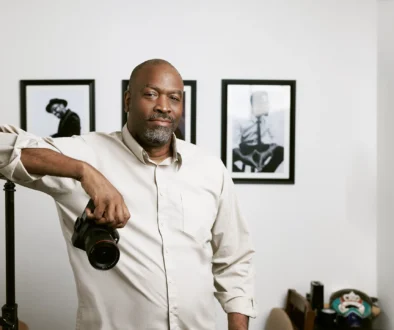
Eric Coleman is a brand photographer in Austin, Texas.
FAQ
Why does my business look less professional than it actually is? Because your capability improves continuously and your materials only change when you deliberately change them. The gap opens by default, not by mistake.
How do I know if my branding is outdated? Write down the five most significant things that have happened in your business in the last two years, then look for them in your public materials. If they aren’t there, your materials are describing an older version of you.
How often should I update my website and photos? Less about the calendar, more about whether the last two years show up anywhere. If they don’t, you’re overdue regardless of the date on the files.
Why can’t I tell whether my own site looks good? The curse of knowledge. You supply all the missing context automatically when you look at it, and you can’t turn that off. It’s the same reason a person tapping a song can’t hear how the taps sound to somebody else.
SOURCES
- Newton, E. (1990). Overconfidence in the Communication of Intent: Heard and Unheard Melodies. Doctoral dissertation, Stanford University. 120 songs tapped, 3 identified correctly, tappers predicted 50 percent.
- Gilovich, T., Savitsky, K., and Medvec, V. (1998). The Illusion of Transparency: Biased Assessments of Others’ Ability to Read One’s Emotional States. Journal of Personality and Social Psychology, 75(2), 332 to 346. Liars estimated detection near 49 percent against an actual rate near 26 percent.
- Gilovich, T., Medvec, V., and Savitsky, K. (2000). The Spotlight Effect in Social Judgment. Journal of Personality and Social Psychology, 78(2). The Barry Manilow t-shirt study.
- Gilovich, T., and Savitsky, K. (1999). The Spotlight Effect and the Illusion of Transparency. Current Directions in Psychological Science, 8(6). On both biases running on an egocentric anchoring mechanism.
Note on source 1. Newton’s study is a dissertation rather than a journal article, and most people encounter it through Made to Stick. Cite the dissertation directly. It’s the correct attribution and almost nobody bothers.